![Asset 1.png]](https://knowledge.reachreporting.com/hs-fs/hubfs/Asset%201.png?height=22&name=Asset%201.png)
In this article:
- Overview
- Types of Data Sheets
- Using Sheets Data in Metrics and Statements
- Using Sheets Data as Live Text
- Sheets in Consolidations
- Keeping Sheets Data Current
- Tips and Best Practices
Overview
Sheets are the best place to add any data that doesn't come directly from your bookkeeping integration. This can include monthly metrics like "new customers," "total sales calls," "headcount," or "website visitors," as well as any additional data you'd like to track alongside your financials to bring more context and insight into your reports.
Once a Data Sheet is set up, its data can be referenced in metrics, statements, live text, and report or dashboard elements throughout Reach Reporting.
Types of Data Sheets
There are three options for bringing external data into Reach Reporting.
Reach Sheets
Reach Sheets allow you to manually enter and store custom data directly inside Reach Reporting. When you open a Reach Sheet, you will notice it has the same format as the Metric and Statement Builder, without the bottom preview tab and additional settings.
Inside a Reach Sheet, you can:
- Pull in accounts from your bookkeeping software
- Enter custom data such as the number of employees, website visitors, or sales calls
- Build calculations using formulas across your data rows
One key advantage of Reach Sheets is that there is no syncing required. Once data is entered, it is immediately available to reference anywhere in Reach Reporting.
See our Data Sheets article for full setup instructions and formatting requirements.
Google Sheets
You can connect a Google Sheet to upload external data. Google Sheets can be useful if you want to give multiple users the ability to collaborate simultaneously in the sheet, or if you want users to be able to edit external data outside of Reach Reporting. Using the Reach Reporting Google Sheet template, these function the same as Reach Sheets but are maintained externally.
See our Google Sheets Data Sheets article for full setup instructions and formatting requirements.
Excel Sheets
If you prefer to work in Excel, you can upload an Excel file directly to Reach Reporting using the Excel Sheet option in the Sheets section. Like Reach Sheets and Google Sheets, Excel Sheet data is available to reference anywhere in Reach Reporting once uploaded. If the Excel file is updated, you will need to re-upload it to reflect the changes.
See our Excel Data Sheets article for full setup instructions and formatting requirements.
Using Sheets Data in Metrics and Statements
Once a Sheet is created, you can access its data anywhere in Reach Reporting through the Metric and Statement Builder.
To add Sheets data to a metric or statement:
- Create a new metric or statement, or open an existing one you want to edit.
- Click Add Data / Rows > Data.
- In the data picker, select Data Sheets or Google/Excel under Other Sources.
- Choose the sheet and the specific row(s) you want to include.
- Click Add Data.
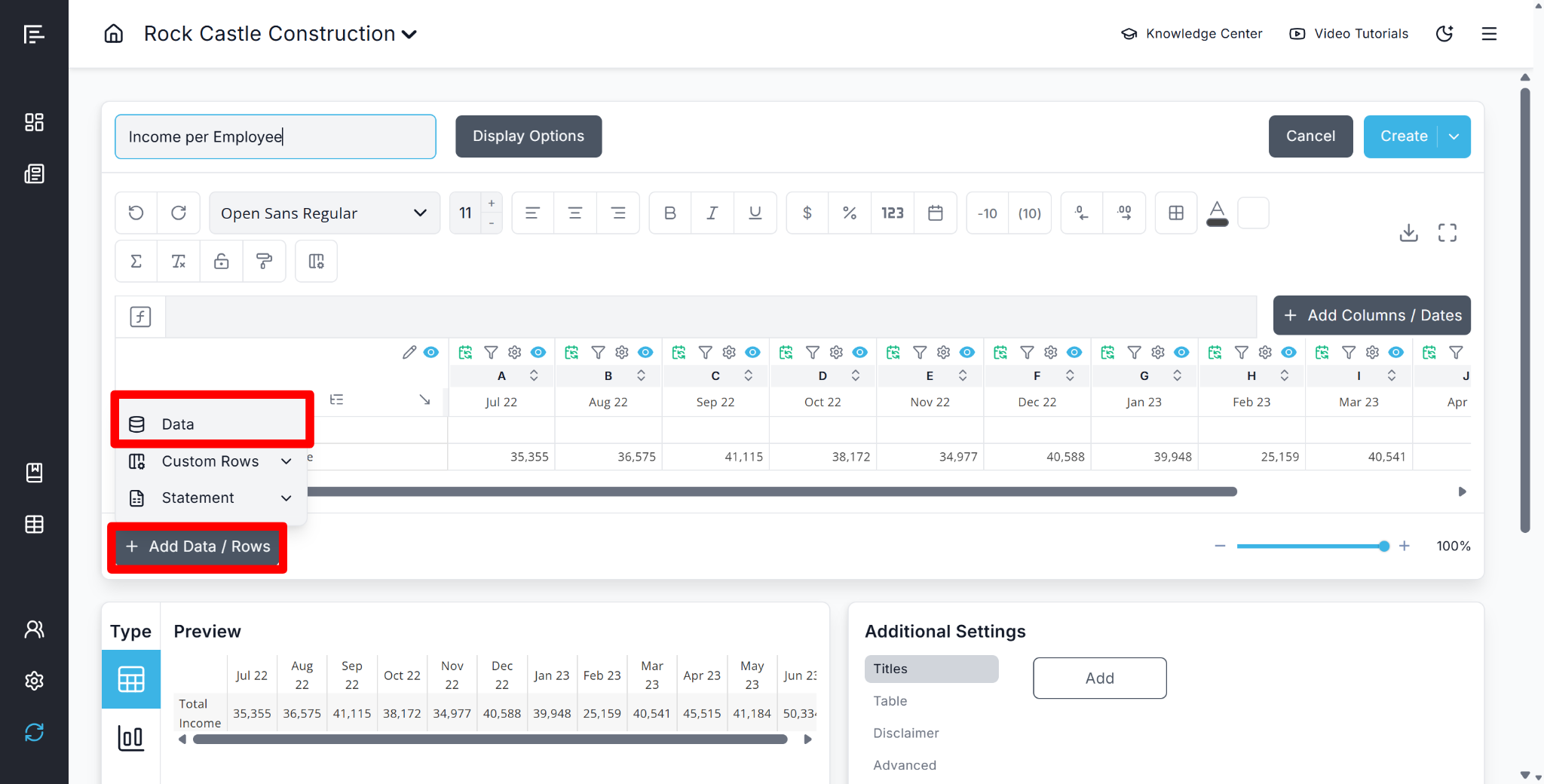
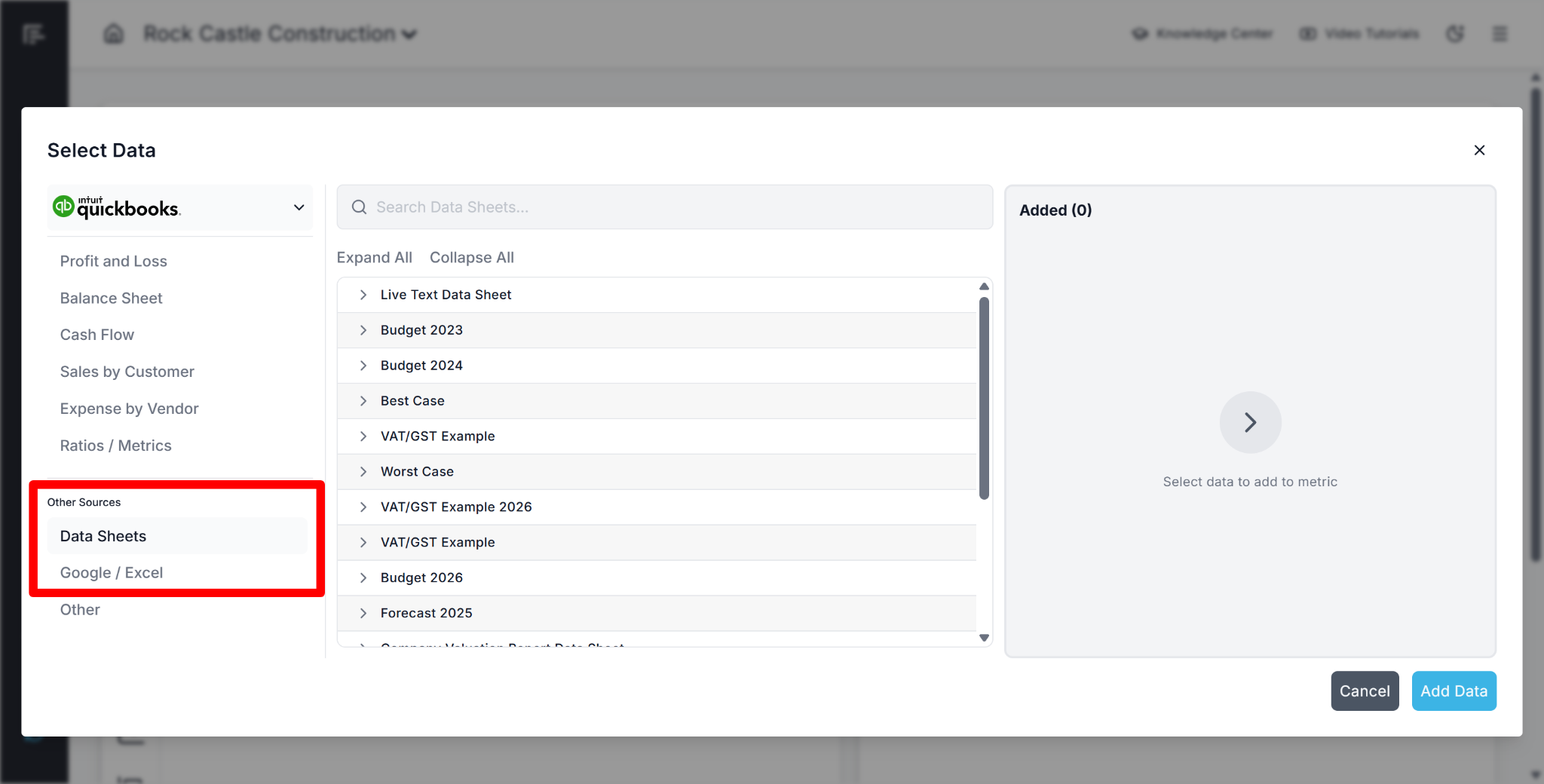
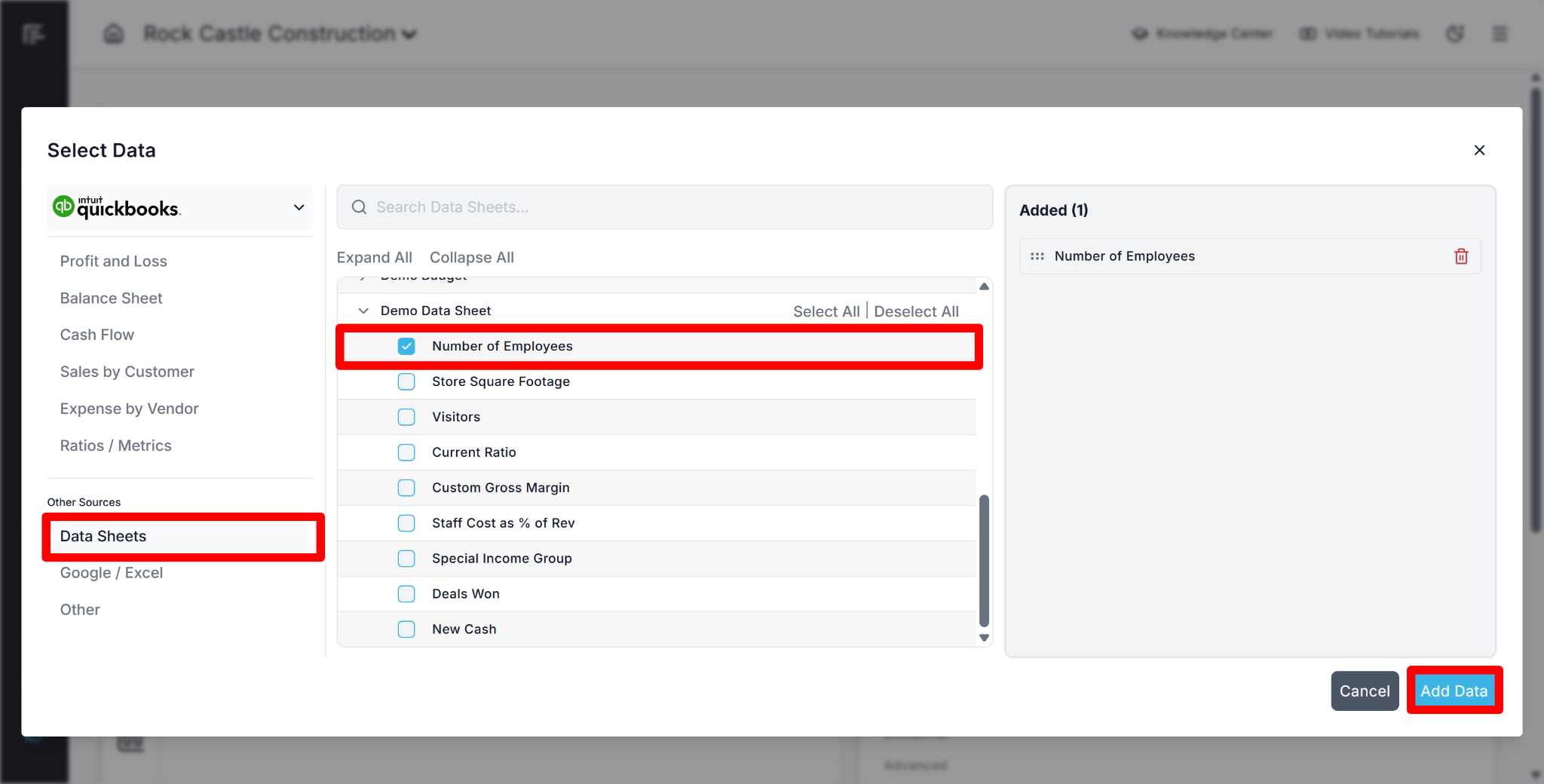
You can have multiple metrics and statements referencing various Sheets. This means you only need to update the Sheet itself, and all metrics and statements that reference it will reflect the change automatically. See Keeping Sheets Data Current if you plan on making changes to the Sheet.
Using Sheets Data as Live Text
Sheets data can also be used as custom live text in your reports and dashboards. This is useful for displaying non-financial metrics like customer counts, headcount, custom KPIs, or calculated ratios alongside your financial data.
See the Using Data Sheet Data for Live Text section of the Live Text article for full instructions on how to create custom live text from Sheets data, including step-by-step setup for both reports and dashboards.
Sheets in Consolidations
If you are working with consolidated reporting, Sheets can be used at the company level and referenced in consolidated reports. See the Using Company-Level Data Sheets in Consolidations section in our Consolidations article for more information.
Keeping Sheets Data Current
How you keep your Sheets data up to date in your dashboards or reports depends on which sheet type you are using:
- Reach Sheets updates immediately when data is entered or edited, without requiring a sync.
- Google Sheets require a manual sync in Reach Reporting each time the Google Sheet is updated. Click the Sync button next to the sheet in the Sheets section after making changes.
- Excel Sheets require a re-upload each time the Excel file is updated.
If you are using Data Sheet data as a reference in a budget or forecast, see the Refreshing Data Sheet Referenced Data section of the Budgeting with Reference Data article for information on keeping that data current in your planning tools.
Tips and Best Practices
- Combine financial and non-financial data in a single metric. Pairing bookkeeping accounts with Data Sheet rows — such as showing revenue alongside headcount or new customers — makes for more insightful and complete reporting.
- Use the same Data Sheet across multiple metrics. Because metrics update automatically when a Data Sheet is changed, centralizing your external data in one sheet keeps everything consistent and reduces manual updates.
- Use Reach Sheets for internal data; Google or Excel Sheets for external contributors. If a third party or multiple collaborators need to supply data, Google Sheets or Excel Sheets are the better fit since they don't require Reach Reporting access.
- Remember to sync Google Sheets and re-upload Excel Sheets after updates. Unlike Reach Sheets, these require a manual step to pull in new data before your metrics and dashboards will reflect changes.
- Use Data Sheet data as live text for a richer narrative. Custom live text lets you surface non-financial KPIs like customer counts or calculated ratios directly on report pages or dashboard tiles, alongside your financial data.
Go to the Reach Reporting app>
ARE YOU NOT CURRENTLY USING REACH REPORTING?
learn more at reachreporting.com
We are dedicated to helping you.
- Need Additional Help?
Your success is important to us.
Whether you're working as a CFO of a business or part of an accounting firm, Reach Reporting is here to improve your working knowledge of reporting and provide service tips and skills to ensure you're at the top of your game.
We make sure that you have access to staff members who are best suited to help you. We work together to resolve issues and create memorable moments that empower you to enhance your reporting skills.
We are here to listen to you. We understand that using new technology can be frustrating, so we can answer questions or jump on a quick Zoom call. Our entire staff has an in-depth knowledge of Reach Reporting and can quickly direct you to best practices to improve your reporting.
We are focused on providing solutions that save you time and increase your value. We continue to improve each day and look forward to visiting with you. Your communication with us is vital and appreciated.
Please feel free to chat with us by clicking the help chat bubble in the lower right-hand corner of this page.
Reach out to your Reach Reporting Rep and schedule a Zoom meeting by clicking the meeting link in their email signature.
Or schedule to join our ongoing webinars.
Reach Reporting is dedicated to helping provide a knowledge base that is easy to understand and informative. If you still have questions that have not been answered, please let us know by emailing support@reachreporting.com, chatting with our support team, or calling us at (877) 467-7637. We are here to ensure that you have a positive experience with Reach Reporting, as we want to continue to be the reporting solution you trust.
Need more access to Reach Reporting Resources?
Reach Reporting has a wealth of knowledge and a robust online community to support you as you create reports that provide powerful insight. Please look into the following resources.
Reach Reporting Blog: We add blogs to our site every month to give you great information in a fun and friendly manner.
Case Studies: We interview one company per month to help our clients highlight how they are using Reach Reporting and how it is improving their services and firm offerings. These case studies are invaluable to our community.
Knowledge Center: From simple to complicated, we provide step-by-step guidance to utilize every aspect of Reach Reporting in our robust knowledge center.
Video Tutorials: We know watching is sometimes easier than reading, which is why all of our tutorials are video-based in the video tutorial section of Reach Reporting and Youtube.
Social Networks: Join us on FaceBook, LinkedIn, Youtube, and Twitter.
Monthly Newsletter: Go to the footer of reachreporting.com and sign up to receive the Reach Reporting newsletters delivered directly to your inbox. Our newsletters cover tips and tricks, current events in accounting, strategies to improve your advisory services, and much more.
We look forward to helping you build insightful reports,
The Reach Reporting Team.