![Asset 1.png]](https://knowledge.reachreporting.com/hs-fs/hubfs/Asset%201.png?height=22&name=Asset%201.png)
In this article:
- Overview
- How the Book Month Works
- Accessing and Changing the Book Month
- Using the Book Month with Dashboards
- Using the Book Month with Report Templates
- Important Notes About Live Dates
- Best Practices
- Troubleshooting
Overview
The Book Month is one of the most powerful features in Reach Reporting. It acts as your last closed month and enables reports and dashboards to automatically update using live dates. This means you can build reports once and have them dynamically adjust to different time periods without rebuilding anything.
How the Book Month Works
The Book Month represents the most recent month for which your bookkeeping is complete. By default, it is set to the last month, but you can modify it at any time to view data from different periods.
When you change the Book Month:
- Live dates and live text automatically update throughout your reports and dashboards
- Metrics and statements that use live date ranges adjust accordingly
- Custom equations respond to date changes without manual updates
This powerful functionality allows you to roll forward or backward through time periods effortlessly, making it easy to review historical data or prepare reports for different months.
Accessing and Changing the Book Month
You can view and modify the Book Month in two locations:
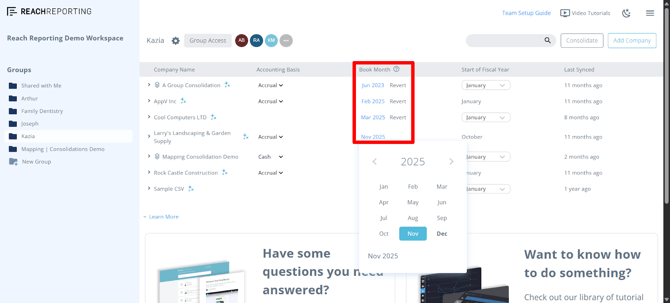
From the Workspace Home
- Navigate to your Workspace Home
- You will see a Book Month displayed for every connected company
- Click on the Book Month next to any company to change it
- Select your desired month
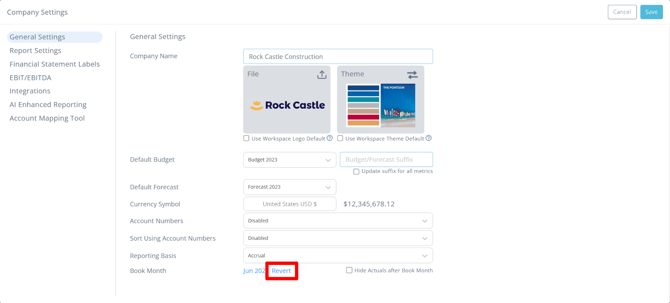
From Company Settings
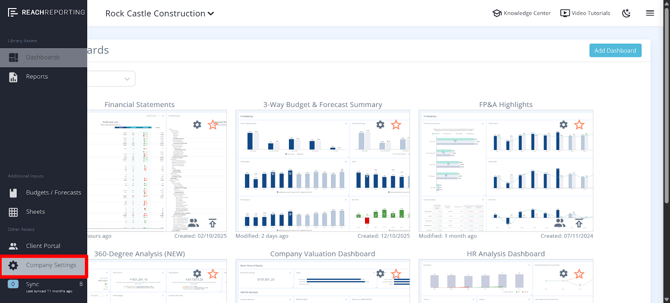
- Open the company in Reach Reporting
- Click the gear icon in the lower left corner
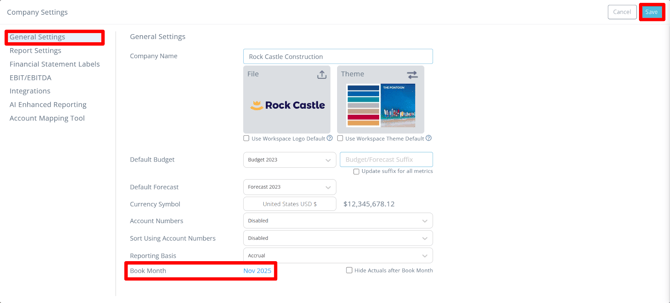
- Navigate to the Book Month setting
- Select your desired month
- Click Save
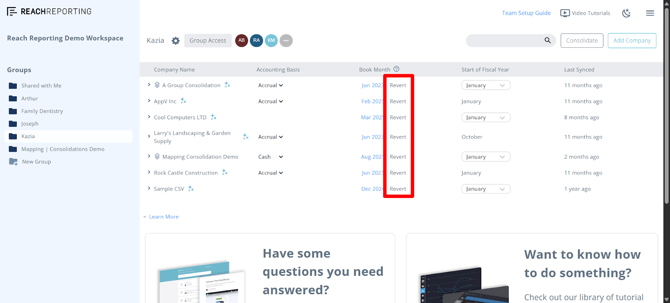
Important: If you manually change the Book Month, you will see a "Revert" button next to it. This indicates that the Book Month has been modified from its default setting and will not automatically update each month. Click "Revert" to return to the default behavior where the Book Month automatically updates to the last month.
Using the Book Month with Dashboards
Dashboards leverage the Book Month to provide dynamic, up-to-date visualizations:
- Open any dashboard in your company
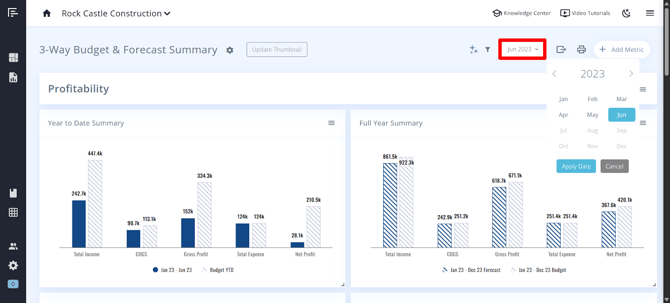
- Change the Book Month in your company settings (click the gear icon in the bottom left)
- Save your changes and refresh the dashboard
- All metrics using live dates will automatically update to reflect the new Book Month
- You can use the Last Closed Month Dropdown to show historical data up until your book month. This feature can also be shared with your audience. Check out this Knowledge Center article on How to Publish Dashboards to learn how to toggle this setting
This feature allows you to quickly view how your business performed in different time periods without rebuilding metrics or creating duplicate dashboards.
Using the Book Month with Report Templates
Report templates in Reach Reporting use live dates that automatically adjust based on your Book Month setting. Understanding how the Book Month affects different report types is essential for accurate reporting.
Monthly Report Templates
Monthly reports automatically display data based on your current Book Month setting. If your Book Month is set to March 2026, monthly reports will show March 2026 data.
Quarterly Report Templates
Quarterly reports display data for the most recently completed quarter based on your Book Month:
- If your Book Month is set to March 2026, quarterly reports will show Q1 2026 (January - March 2026)
- If your Book Month is set to June 2026, quarterly reports will show Q2 2026 (April - June 2026)
- If your Book Month is set to August 2026, quarterly reports will show Q2 2026 (April - June 2026)
To view a specific quarter, adjust your Book Month to the last month of that quarter.
Annual Report Templates
Annual reports display data for the last closed year based on your Book Month year setting:
- If you see 2024 data in an annual report and your Book Month is set to any month in 2025 (e.g., December 2025), the report shows 2024 as the last closed year
- To display 2025 data in your annual report, update the Book Month to any month in 2026 (e.g., January 2026 or later)
Fiscal Report Templates
You can search "Fiscal" within the Reach Reporting Report Library to view pre-made report templates that were designed to follow the fiscal year. You can also check the Report Description to check if the report is utilizing a fiscal year date range:
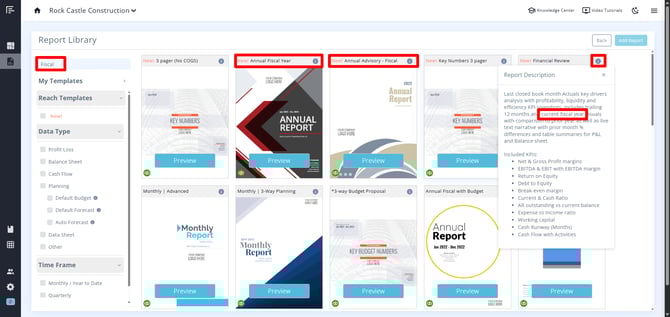
If your company uses a fiscal year that differs from the calendar year:
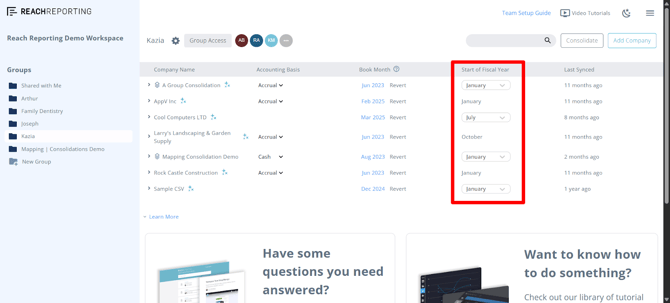
- The start of the Fiscal Year will follow the month set in your bookkeeping software. If you are working in a Consolidation or a CSV trial balance, you can set the start of the Fiscal Year in the Workspace:
- Quarterly fiscal reports will display the last completed quarter based on your Book Month
- For example, if your fiscal year runs July - June and your Book Month is August 2026, the quarterly fiscal reports will show Q4 FYE 2026 (April 2026 - June 2026)
- If your fiscal year runs July - June and your Book Month is September 2026, the quarterly fiscal reports will show Q1 FYE 2026 (July 2026 - September 2026)
- To view a specific quarter, adjust your Book Month to the last month of that quarter
- Annual fiscal year reports will display the last completed fiscal year based on your Book Month
- For example, if your fiscal year runs July - June and your Book Month is August 2026, annual fiscal reports will show the fiscal year July 2025 to June 2026
Year-to-Date Report Templates
Year-to-date reports will display data from the start of the company’s Fiscal Year to your current Book Month setting.
If the start of the Fiscal Year is set to July and the Book Month is set to March 2026, the Year-to-Date report will display July 2025 to March 2026.
Important Notes About Live Dates
Live Dates vs. Static Dates:
- Metrics, statements, and live text with live dates enabled will automatically update when you change the Book Month
- Any content with live dates disabled will NOT update when the Book Month changes
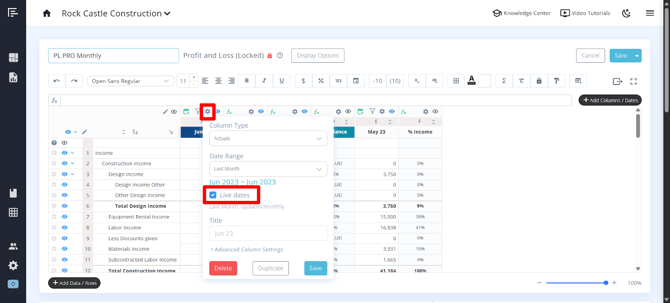
- When building metrics or statements, you can turn the live dates on or off by clicking the gear icon above a column and toggling the "Live Dates" option
Best Practices
- Keep Book Month on Default: Unless you need to review historical data, leave the Book Month on its default setting (with no "Revert" button visible), so it automatically updates each month
- Refresh After Changes: Always refresh your browser after changing the Book Month to ensure all metrics and statements update properly
- Check Report Dates: When using report templates, verify that the displayed date ranges match your intended reporting period, especially for annual reports
- Freeze Reports When Needed: To preserve a report for a specific time period:
- Set the Book Month to the desired period
- Export the report as a PDF or save it to the Client Portal
- The exported version will remain static regardless of future Book Month changes
- Use for Multiple Periods: The Book Month makes it easy to generate reports for different time periods without creating separate templates - simply change the Book Month, export your report, then change it again for the next period
Troubleshooting
Problem: My annual report is showing the wrong year
- Solution: Check your Book Month year. The annual report shows the last closed year. If you want to see 2025 data, your Book Month must be set to any month in 2026.
Problem: My metrics aren't updating when I change the Book Month
- Solution: Check if live dates are enabled. Edit the metric/statement, click the gear icon above the column, and ensure "Live Dates" is checked.
Problem: My Book Month isn't automatically updating each month
- Solution: Look for the "Revert" button next to the Book Month. If present, click it to return to automatic monthly updates.
The Book Month feature empowers you to build flexible, dynamic reports that adapt to your needs. By understanding how to use it effectively, you can streamline your reporting process and quickly access data from any time period.
If you have questions about using the Book Month, please contact our support team via chat or email at support@reachreporting.com.
Go to the Reach Reporting app>
ARE YOU NOT CURRENTLY USING REACH REPORTING?
learn more at reachreporting.com
We are dedicated to helping you.
- Need Additional Help?
Your success is important to us.
Whether you're working as a CFO of a business or part of an accounting firm, Reach Reporting is here to improve your working knowledge of reporting and provide service tips and skills to ensure you're at the top of your game.
We make sure that you have access to staff members who are best suited to help you. We work together to resolve issues and create memorable moments that empower you to enhance your reporting skills.
We are here to listen to you. We understand that using new technology can be frustrating, so we can answer questions or jump on a quick Zoom call. Our entire staff has an in-depth knowledge of Reach Reporting and can quickly direct you to best practices to improve your reporting.
We are focused on providing solutions that save you time and increase your value. We continue to improve each day and look forward to visiting with you. Your communication with us is vital and appreciated.
Please feel free to chat with us by clicking the help chat bubble in the lower right-hand corner of this page.
Reach out to your Reach Reporting Rep and schedule a Zoom meeting by clicking the meeting link in their email signature.
Or schedule to join our ongoing webinars.
Reach Reporting is dedicated to helping provide a knowledge base that is easy to understand and informative. If you still have questions that have not been answered, please let us know by emailing support@reachreporting.com, chatting with our support team, or calling us at (877) 467-7637. We are here to ensure that you have a positive experience with Reach Reporting, as we want to continue to be the reporting solution you trust.
Need more access to Reach Reporting Resources?
Reach Reporting has a wealth of knowledge and a robust online community to support you as you create reports that provide powerful insight. Please look into the following resources.
Reach Reporting Blog: We add blogs to our site every month to give you great information in a fun and friendly manner.
Case Studies: We interview one company per month to help our clients highlight how they are using Reach Reporting and how it is improving their services and firm offerings. These case studies are invaluable to our community.
Knowledge Center: From simple to complicated, we provide step-by-step guidance to utilize every aspect of Reach Reporting in our robust knowledge center.
Video Tutorials: We know watching is sometimes easier than reading, which is why all of our tutorials are video-based in the video tutorial section of Reach Reporting and Youtube.
Social Networks: Join us on FaceBook, LinkedIn, Youtube, and Twitter.
Monthly Newsletter: Go to the footer of reachreporting.com and sign up to receive the Reach Reporting newsletters delivered directly to your inbox. Our newsletters cover tips and tricks, current events in accounting, strategies to improve your advisory services, and much more.
We look forward to helping you build insightful reports,
The Reach Reporting Team.