![Asset 1.png]](https://knowledge.reachreporting.com/hs-fs/hubfs/Asset%201.png?height=22&name=Asset%201.png)
In this article:
- Step-by-Step Process
- Managing Data Updates
- Working Across Budgets over Multiple Years
- External Data Management
- Final Assembly
- Managing Multi-Year Budget Groups
- Multi-Year Budgets in Consolidations
- Best Practices
- Troubleshooting Tips
- Excel Budget Upload - Alternative to Budgets Pro
Step-by-Step Process
Year 1: Your Initial Budget
- Create your initial budget with all desired settings, row drivers, and data configurations
- Save the budget once complete
Year 2 and Beyond: Duplicate and Modify
- Duplicate Year 1 budget instead of starting from scratch
- Open the duplicated budget and navigate to Advanced Settings
- Change the year using the date dropdown to the following year and save
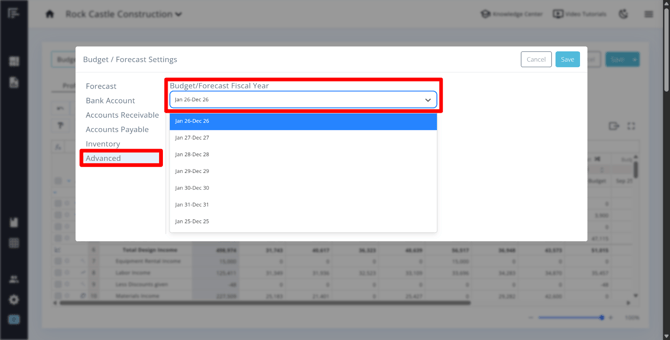
4. Adjust the budget numbers and assumptions as needed for the new year
Connecting Multi-Year Budgets
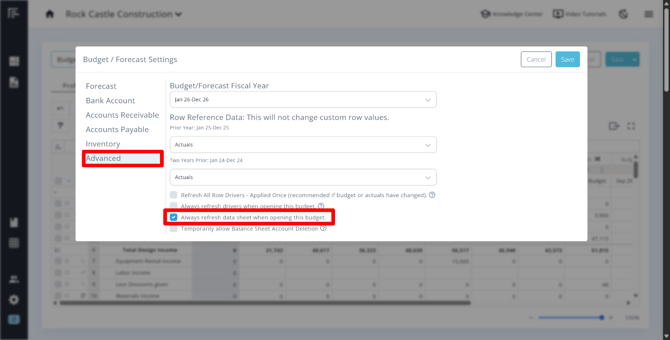
- In Advanced Settings, modify the reference data settings:
- Prior Year: Set to reference the previous year's budget (not actuals)
- Two Years Prior: Will reference actuals from bookkeeping
- This connects the budgets into a true multi-year plan
- Result: The reference column in Year 2 will now pull totals from Year 1 budget
Years 3-5: Extended Planning
For subsequent years, continue the pattern:
- Year 3:
- Prior Year → Year 2 Budget
- Two Years Prior → Year 1 Budget (not actuals)
- Year 4:
- Prior Year → Year 3 Budget
- Two Years Prior → Year 2 Budget
- Year 5:
- Prior Year → Year 4 Budget
- Two Years Prior → Year 3 Budget
Managing Data Updates
When budgets are connected, changes don't flow automatically. Check out our Knowledge Center article on Budgeting with Reference Data for more information on how to refresh the row drivers.
Working Across Budgets Over Multiple Years
Recommended workflow:
- Open multiple browser tabs
- Load a different budget year in each tab
- Make changes in one budget and Save (no need to Save and Close)
- Switch tabs, refresh drivers, and continue
- Repeat as needed across all years
Rolling Forecast
You can convert your budgets into a forecast, if needed, to create a rolling forecast. See the Convert a Budget to a Forecast and Maintaining and Rolling Your Forecast Monthly sections of our How to Create a Forecast article for more information.
External Data Management
Connecting External Data Sheets
For data spanning multiple years:
- Create an external datasheet (Google Sheets, Excel, or Data Sheet) with data for all required months/years
- Connect to each budget's datasheet - each budget will only reference dates within its year
- Enable refresh settings:
- Manual: Click refresh button in datasheet when changes are made
- Automatic: Check "Auto-refresh datasheet on open" in Advanced Settings
Final Assembly
Creating the Complete Multi-Year Plan
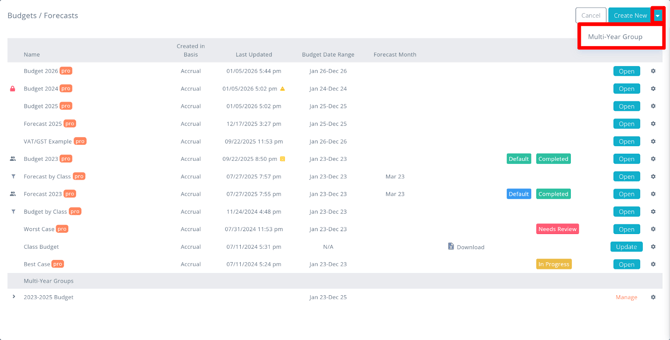
Click the drop-down next to "Create New" and select "Multi-Year Group."
Now you can select the budgets you want to group. You will notice that you will only be able to group budgets from different years and will not be able to group same-year budgets.
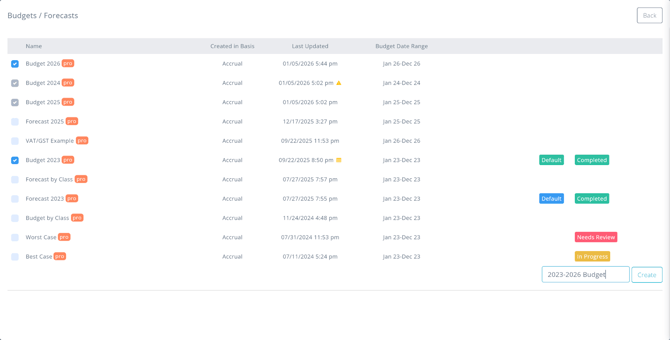
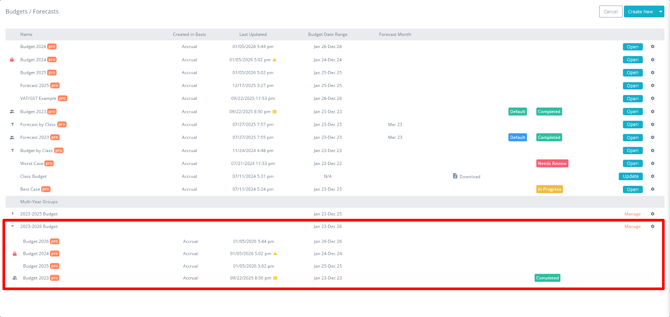
After you save, you will see your new group budget appear in the group budget section.
Managing Multi-Year Budget Groups
Next to the group budget, you will notice a couple of options for managing your multi-year budget:
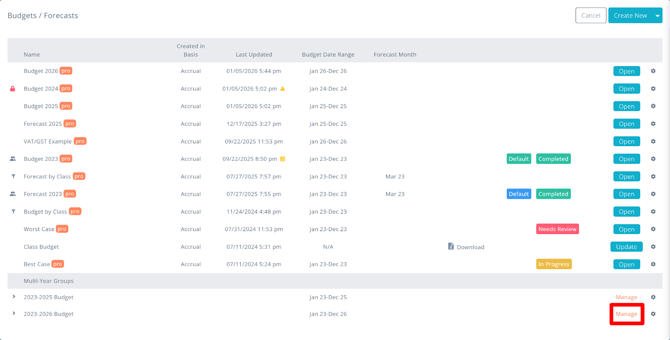
Manage Button: You can use this button to add an additional year to the group budget or switch out a previously selected budget.
Delete Option: If you click the gear icon, you will also see the option to delete the group budget. This will only remove the group budget and leave the budgets included in the group budget alone.
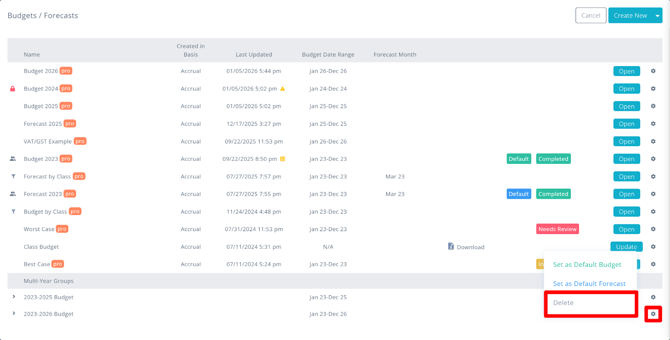
Set as Default: If you click the gear icon, you will see the option to set the Multi-Year group as the default budget or default forecast. The biggest benefit of grouping budgets is being able to set a group budget as your default, allowing you to build metrics and reports with multiple years of budget data without having to switch out the budget for each column.

Report Template: We have added a 3 YR Financial Projection template to help showcase this feature and demonstrate how you might use a 3-year group budget in a report.
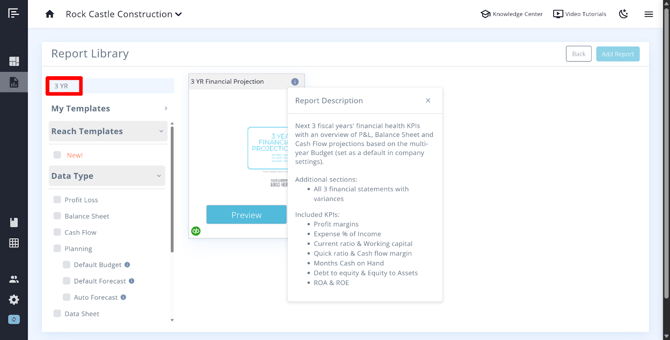
You will be able to edit the single budgets that are included in the group budget, and those changes will roll over.
Multi-Year Budgets in Consolidations
Multi-year budgets can also be used for consolidations, allowing you to plan and analyze across multiple entities and multiple years simultaneously. Check out our Knowledge Center article on Budgets and Forecasts in Consolidations to learn more.
Best Practices
- Duplicate rather than recreate to maintain consistency
- Save frequently when making changes
- Refresh drivers after updating reference budgets
- Use external datasheets for complex multi-year assumptions
Troubleshooting Tips
- If drivers aren't updating, check refresh settings
- Verify reference periods are correctly set in Advanced Settings
- Ensure external datasheets are properly connected
- Remember that changes require a manual or scheduled refresh to propagate
Excel Budget Upload - Alternative to Budgets Pro
The Excel budget option is another alternative for multi-year budgeting.
Check out the How to Create an Excel Budget in Reach Reporting article to get started.
Creating an Excel Budget with Multiple Years
- Follow the steps in the How to Create an Excel Budget in Reach Reporting article
- Modify the template to include additional years:
- The template comes with one fiscal year by default
- Add columns for additional months/years as needed
- Maintain the same formatting structure
- Fill in your budget data for the additional years:
- Manually enter your budget amounts, or
- Copy and paste budget data from your bookkeeping software
- Ensure all dates and amounts are correct
- Upload your Excel file:
- Return to the Budget/Forecast section, “Use Excel” option
- Select "Choose File"
- Choose your completed Excel file
- Review and confirm the upload
Go to the Reach Reporting app>
ARE YOU NOT CURRENTLY USING REACH REPORTING?
learn more at reachreporting.com
We are dedicated to helping you.
- Need Additional Help?
Your success is important to us.
Whether you're working as a CFO of a business or part of an accounting firm, Reach Reporting is here to improve your working knowledge of reporting and provide service tips and skills to ensure you're at the top of your game.
We make sure that you have access to staff members who are best suited to help you. We work together to resolve issues and create memorable moments that empower you to enhance your reporting skills.
We are here to listen to you. We understand that using new technology can be frustrating, so we can answer questions or jump on a quick Zoom call. Our entire staff has an in-depth knowledge of Reach Reporting and can quickly direct you to best practices to improve your reporting.
We are focused on providing solutions that save you time and increase your value. We continue to improve each day and look forward to visiting with you. Your communication with us is vital and appreciated.
Please feel free to chat with us by clicking the help chat bubble in the lower right-hand corner of this page.
Reach out to your Reach Reporting Rep and schedule a Zoom meeting by clicking the meeting link in their email signature.
Or schedule to join our ongoing webinars.
Reach Reporting is dedicated to helping provide a knowledge base that is easy to understand and informative. If you still have questions that have not been answered, please let us know by emailing support@reachreporting.com, chatting with our support team, or calling us at (877) 467-7637. We are here to ensure that you have a positive experience with Reach Reporting, as we want to continue to be the reporting solution you trust.
Need more access to Reach Reporting Resources?
Reach Reporting has a wealth of knowledge and a robust online community to support you as you create reports that provide powerful insight. Please look into the following resources.
Reach Reporting Blog: We add blogs to our site every month to give you great information in a fun and friendly manner.
Case Studies: We interview one company per month to help our clients highlight how they are using Reach Reporting and how it is improving their services and firm offerings. These case studies are invaluable to our community.
Knowledge Center: From simple to complicated, we provide step-by-step guidance to utilize every aspect of Reach Reporting in our robust knowledge center.
Video Tutorials: We know watching is sometimes easier than reading, which is why all of our tutorials are video-based in the video tutorial section of Reach Reporting and Youtube.
Social Networks: Join us on FaceBook, LinkedIn, Youtube, and Twitter.
Monthly Newsletter: Go to the footer of reachreporting.com and sign up to receive the Reach Reporting newsletters delivered directly to your inbox. Our newsletters cover tips and tricks, current events in accounting, strategies to improve your advisory services, and much more.
We look forward to helping you build insightful reports,
The Reach Reporting Team.