---
title: Classes, Departments, and Locations
description: If your company is synced with Class or Department data, you will see a funnel filter that is available when editing a statement or metric. It is located at the top of each column that is a "Data
---
[Skip to content](https://knowledge.reachreporting.com/classes-departments-and-locations#main-content)
![Asset 1.png\]](https://knowledge.reachreporting.com/hs-fs/hubfs/Asset%201.png?height=22&name=Asset%201.png)
Open main navigation
Close main navigation
- [Go to reachreporting.com](https://reachreporting.com/)
[Go to reachreporting.com](https://reachreporting.com/)
How can we help improve your Reach?
- There are no suggestions because the search field is empty.
1. [Knowledge Center](https://knowledge.reachreporting.com/?hsLang=en)
2. [Metrics/Statement Builder](https://knowledge.reachreporting.com/metrics-statement-builder?hsLang=en)
3. [Customizing a Metric](https://knowledge.reachreporting.com/metrics-statement-builder?hsLang=en#customizing-a-metric)
# Classes, Departments, and Locations
## Class, department, and location filters for QuickBooks Online, QuickBooks Desktop, and Xero integrations.
### **In this article:**
- [Overview](https://knowledge.reachreporting.com/classes-departments-and-locations#overview)
- [Filtering by Class in Metrics and Statements](https://knowledge.reachreporting.com/classes-departments-and-locations#metris-and-statements)
- [Multi-Select: Building Columns by Class](https://knowledge.reachreporting.com/classes-departments-and-locations#multi-select)
- [Filtering Live Text by Class or Department](https://knowledge.reachreporting.com/classes-departments-and-locations#live-text)
- [In a Report](https://knowledge.reachreporting.com/classes-departments-and-locations#report-live-text)
- [Filtering Existing Live Text in a Report](https://knowledge.reachreporting.com/classes-departments-and-locations#exisiting-live-text)
- [In a Dashboard](https://knowledge.reachreporting.com/classes-departments-and-locations#dashboard-live-text)
- [Filtering the Dashboard by Class](https://knowledge.reachreporting.com/classes-departments-and-locations#filtering-dashboard)
- [Unassigned Classes](https://knowledge.reachreporting.com/classes-departments-and-locations#unassigned-classes)
- [Filtering by Class in Consolidations](https://knowledge.reachreporting.com/classes-departments-and-locations#consolidations)
- [Budgeting by Class](https://knowledge.reachreporting.com/classes-departments-and-locations#budgeting-by-class)
- [QuickBooks Desktop: Enabling Class Sync](https://knowledge.reachreporting.com/classes-departments-and-locations#qbd-class-sync)
- [Related Articles](https://knowledge.reachreporting.com/classes-departments-and-locations#related-articles)
---
### **Overview**
If your company file uses Classes, Departments, or Locations, Reach Reporting will sync that data and make it available as a filter throughout the platform — in metrics, statements, and live text.
**Xero users:** In Xero, Classes, Departments, and Locations are referred to as **Tracking Categories**. Reach Reporting syncs these tracking categories and displays them in the same way as classes and departments from QuickBooks.
**Note:** At this time, Reach Reporting **does not support** filtering by **Customer**, **Job**, or **Project,** filtering by **Subclass for Xero** integrations, or filtering by **Classes, Departments, or Jobs for Myob integrations**.
---
### **Filtering by Class in Metrics and Statements**
When editing a metric or statement, a **funnel icon** appears at the top of each **Data** column. Clicking the funnel allows you to filter that column by one or more classes, departments, or locations.
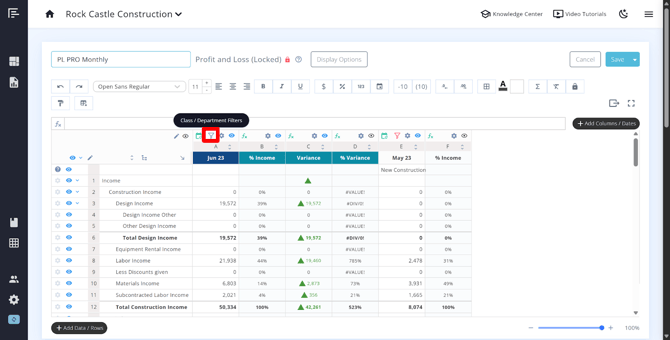
If the funnel icon appears **red**, it means a filter is currently applied to that column.
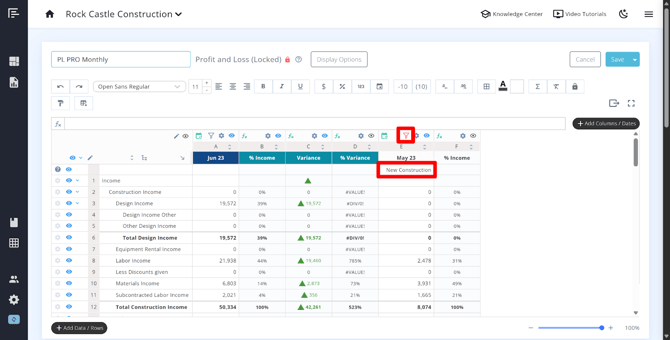
**Note:** The class filter funnel icon is not available on all column types. It will not appear on Actuals vs. Budget/Forecast, Google/Excel (non-date), Custom, or Budget/Forecast columns where the budget or forecast has not been set up by class.
You can also **filter an individual row by class** by clicking the **gear icon** next to that row. A row-level class filter will override any filter applied to the column for that specific row.
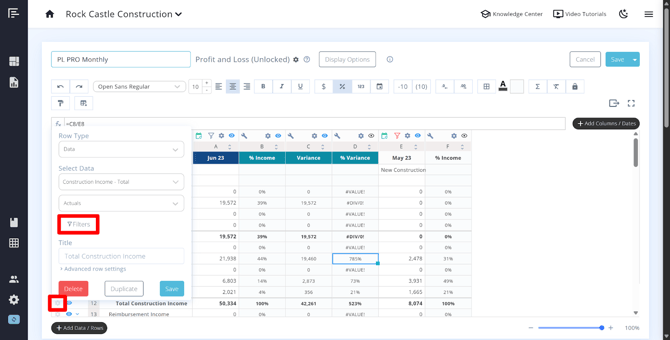
**Note:** Filtering an individual row by class in a **Statement** will require you to [Unlock the Statement](https://knowledge.reachreporting.com/unlocked-statements?hsLang=en).
There is no way to apply a single class filter to an entire report all at once — each metric, statement, or live text element must be filtered individually.
**Two methods are available for filtering by class in metrics and statements:**
1. **Funnel Icon (Column Filter)** — This is the most common method. When editing a metric or statement, click the funnel icon above a data column to filter that column by class. This sets a static class filter for that column.
2. **Display Options (Live Filter)** — This is a more dynamic option. Display Options allows you to add multiple class filters to a single metric or statement and toggle between them directly on the report or dashboard. The selected class will be retained when the report or dashboard is exported as a PDF. See[Display Options: Class/Dept Filter Override](https://knowledge.reachreporting.com/display-options-class/dept-filter-override?hsLang=en) for full details.
---
### **Multi-Select: Building Columns by Class**
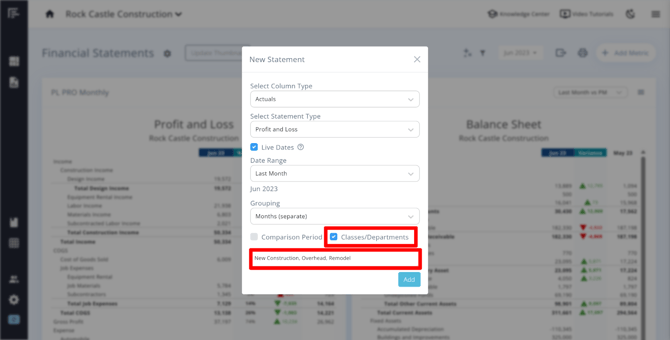
When building a new metric or adding columns to an existing metric, you can create actuals **columns separated by Classes/Departments with a single click** — no extra setup required. This makes it easy to view side-by-side comparisons across classes or departments instantly.
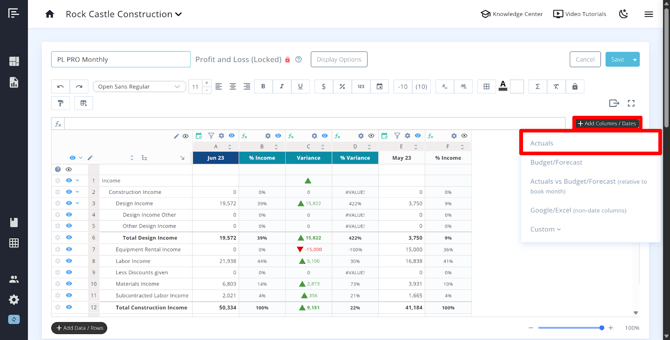
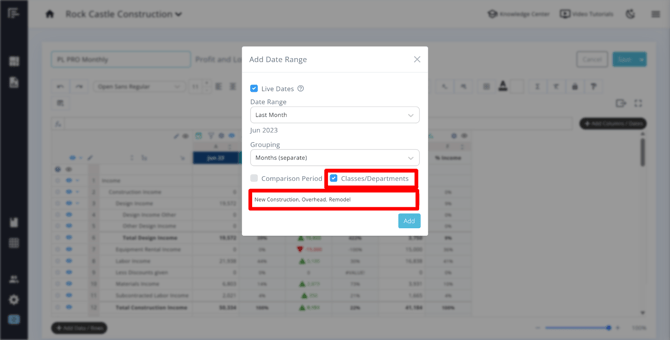
This multi-select class feature is also available **when building a statement from scratch**.
---
### **Filtering Live Text by Class or Department**
You can filter live text by class or department in a Report or Dashboard.
#### **In a Report:**
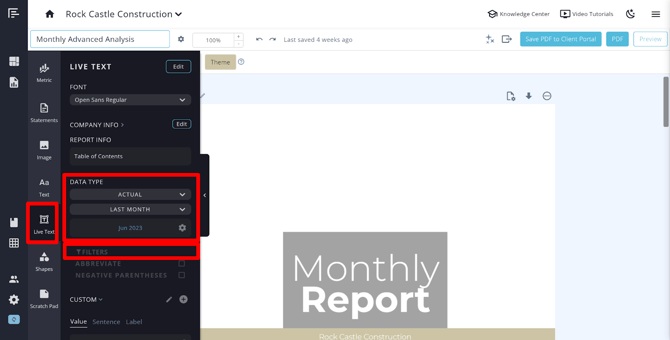
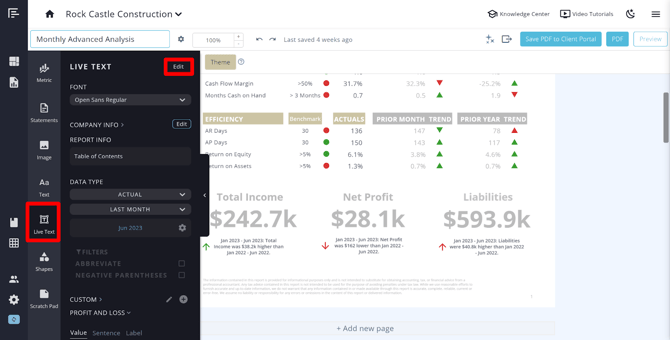
1. Open a report and click **Live Text** from the left toolbar.
2. Select your **data type** (Actuals, Budget, or another comparison type).
3. Set your desired **time frame**.
4. Click the **Filter** option to select the classes or departments you want to filter by.
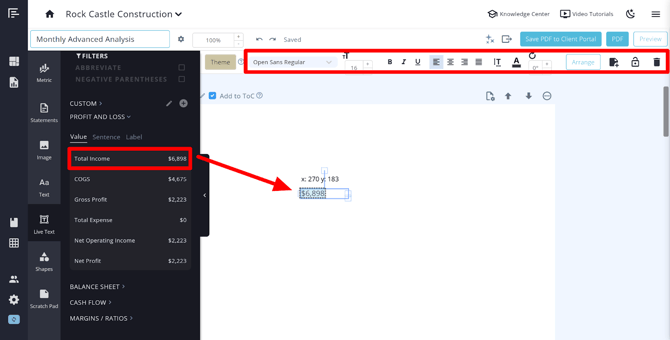
5. Scroll down, find the data you wish to display, and drag it onto the page.
6. Use the top toolbar to adjust the appearance of the text, just as you would with any other text element.
##### **Filter Existing Live Text in a Report**
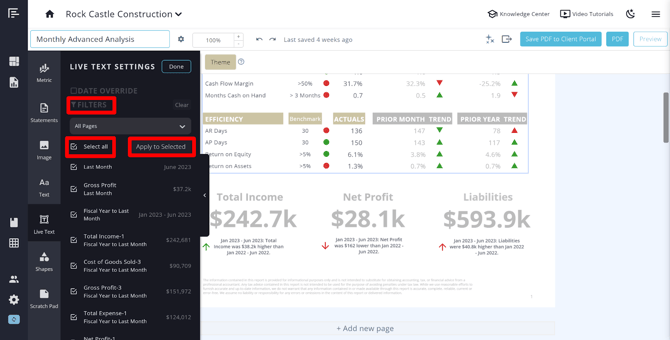
To update the class filter on existing live text, open the Live Text menu and click **Edit** \> **Filters** \> select classes/departments \> select the live text you want to apply changes to \> select **Apply to Selected**:
#### **In a Dashboard:**
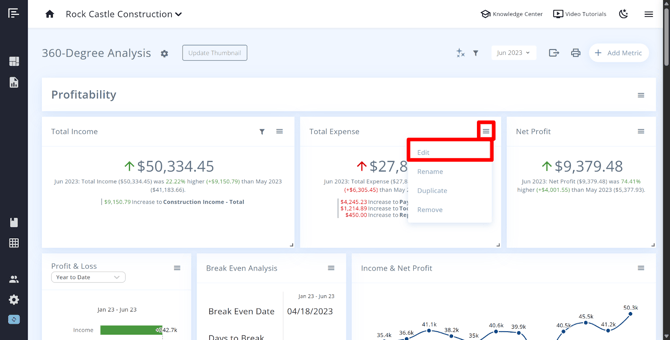
1. Open the hamburger menu on the live text you want to filter and select **Edit**
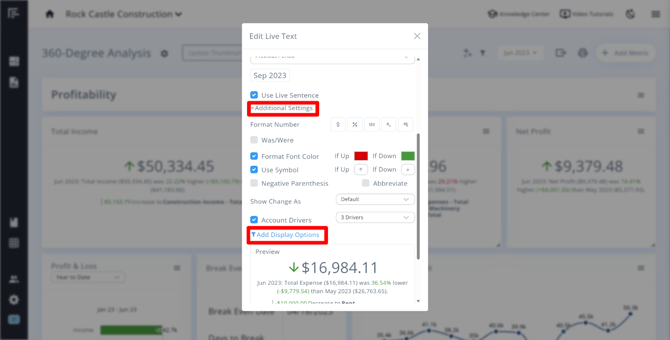
2. Scroll down to the **Additional Settings** and click **Add Display Options**
3. Select the **Class/Department Filters** tab and enable this option
4. **Save** changes
5. Use the **funnel icon** above the live text to filter by class or department
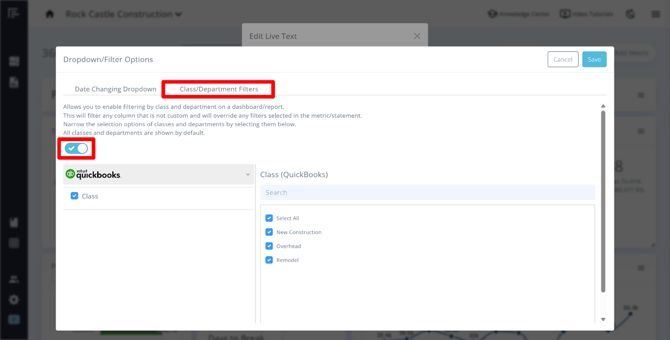
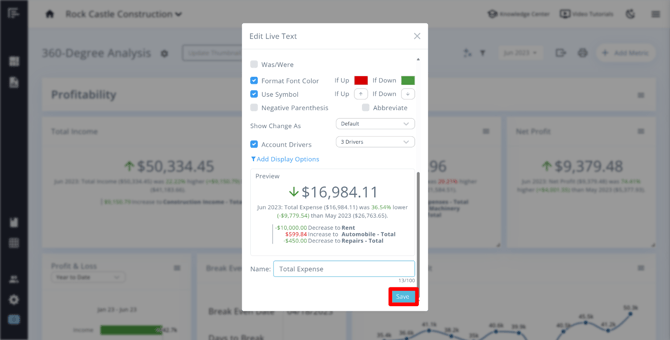
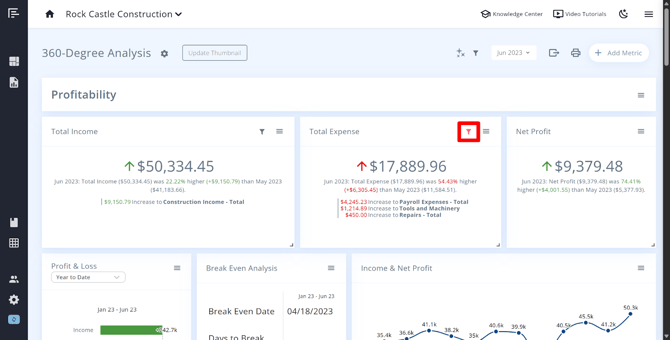
**Important:** The dashboard class filter does **not** persist for live text. When a dashboard is opened, live text will always default to displaying **Total** data. The class filter can then be applied to change the view, but this selection is not saved — it resets each time the dashboard is opened.
---
### **Filtering the Dashboard by Class**
Dashboards include a **class filter** at the top of the dashboard that allows you to filter the entire dashboard view by class, department, or location with a single selection. This makes it easy to switch between class views when presenting or reviewing data.
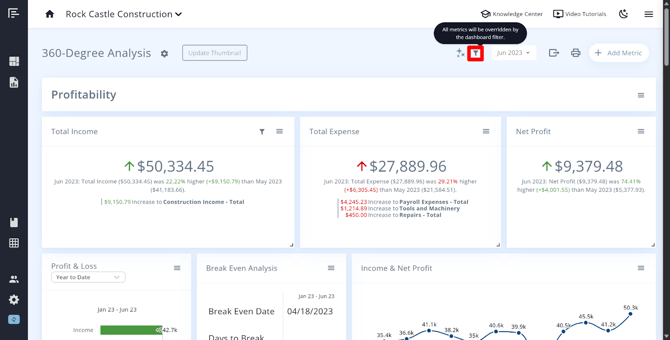
**Important:** The dashboard class filter does **not** persist for live text or metrics on the dashboard. When a dashboard is opened, live text and metric elements will always default to displaying **Total** data. The class filter can then be applied to change the view, but this selection is not saved — it resets each time the dashboard is opened.
---
### **Unassigned Classes**
Transactions in your accounting software that have not been assigned to a class, department, or location will not appear when filtering by any specific class. Reach Reporting does not have a dedicated filter for "Unassigned" items (also known as "Unspecified" or "Not Specified", so these transactions will be excluded from any class-filtered column.
To isolate and display the unassigned amount, you can calculate it manually using a custom column:
1. Build a column with no class filter applied (this represents the total for all transactions, including unassigned ones).
2. Build a second column filtered by all of your classes and departments.
3. Add a custom column with an equation that subtracts the unfiltered column from the filtered column. The resulting value are transactions that have not been assigned to any class.
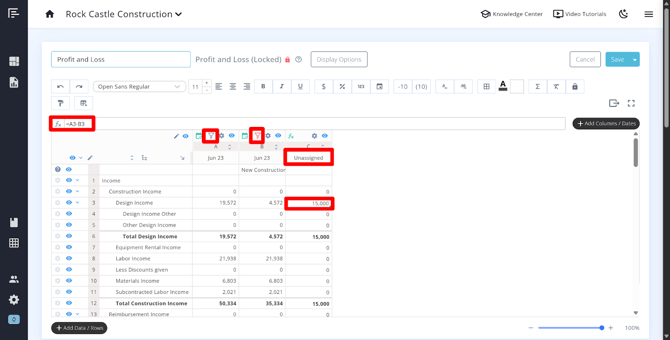
**Tip:** This workaround is useful for identifying transactions that may have been entered in your accounting software without a class assigned, which can be helpful for bookkeeping cleanup as well as reporting accuracy.
---
### **Filtering by Class in Consolidations**
If you are working with consolidated companies, classes and departments from each individual company can be brought into your consolidated metrics and statements. You can filter consolidated data by both entity and class/department to get granular visibility across your consolidation.
For detailed instructions on how to filter consolidated data by class, see[Filtering Consolidated Data in Metrics and Statements](https://knowledge.reachreporting.com/filtering-consolidated-data-in-metrics-and-statements?hsLang=en).
---
### **Budgeting by Class**
Reach Reporting supports budgeting broken down by class or department. This allows you to create detailed, subdivided budgets aligned with your class structure.
For full instructions, see[Budgets by Class](https://knowledge.reachreporting.com/budgets-by-class?hsLang=en).
---
### **QuickBooks Desktop: Enabling Class Sync**
To sync Class data from **QuickBooks Desktop**, you must enable Classes in the Desktop Connector settings. The [Desktop Connector](https://knowledge.reachreporting.com/quickbooks-desktop-integration?hsLang=en) is a downloaded application that runs on your computer and manages syncing for your Desktop company files.
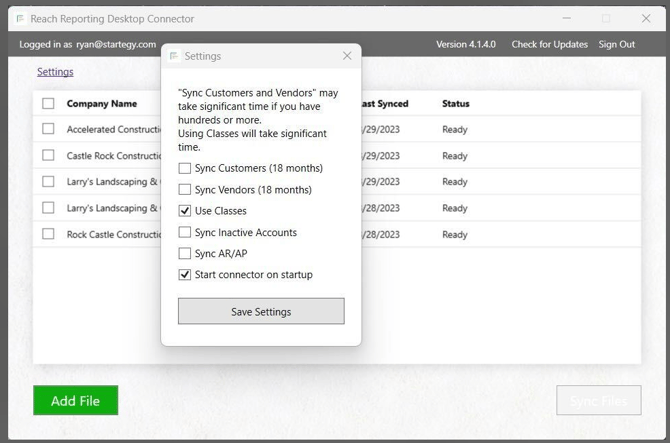
Once Classes are enabled in the Desktop Connector, re-sync your company to bring in the class data.
If you choose to re-sync without classes, it will not eliminate the current class data. In this case, the classes will just not update.
**Note:** Class syncing is **turned off by default** in QuickBooks Desktop because syncing class data significantly increases sync time, depending on the number of classes in your company file.
---
### **Related Articles**
- [Display Options: Class/Dept Filter Override](https://knowledge.reachreporting.com/display-options-class/dept-filter-override?hsLang=en)
- [Budgets by Class](https://knowledge.reachreporting.com/budgets-by-class?hsLang=en)
- [Filtering Consolidated Data in Metrics and Statements](https://knowledge.reachreporting.com/filtering-consolidated-data-in-metrics-and-statements?hsLang=en)
- [Building Metrics and Statements with Reach Reporting](https://knowledge.reachreporting.com/building-metrics-and-statements-with-reach-reporting?hsLang=en)
---
### [**Go to the Reach Reporting app\>**](https://app.reachreporting.com/login)
ARE YOU NOT CURRENTLY USING REACH REPORTING?
[learn more at reachreporting.com](https://reachreporting.com/)
### **We are dedicated to helping you.**
\- Need Additional Help?
*Your success is important to us.*
Whether you're working as a CFO of a business or part of an accounting firm, Reach Reporting is here to improve your working knowledge of reporting and provide service tips and skills to ensure you're at the top of your game.
We make sure that you have access to staff members who are best suited to help you. We work together to resolve issues and create memorable moments that empower you to enhance your reporting skills.
We are here to listen to you. We understand that using new technology can be frustrating, so we can answer questions or jump on a quick Zoom call. Our entire staff has an in-depth knowledge of Reach Reporting and can quickly direct you to best practices to improve your reporting.
We are focused on providing solutions that save you time and increase your value. We continue to improve each day and look forward to visiting with you. Your communication with us is vital and appreciated.
Please feel free to chat with us by clicking the help chat bubble in the lower right-hand corner of this page.
Reach out to your Reach Reporting Rep and schedule a Zoom meeting by clicking the meeting link in their email signature.
Or schedule to join our [ongoing webinars](https://reachreporting.com/webinars).
Reach Reporting is dedicated to helping provide a knowledge base that is easy to understand and informative. If you still have questions that have not been answered, please let us know by emailing support@reachreporting.com, chatting with our support team, or calling us at [(877) 467-7637](https://www.google.com/search?q=reach+reporting&rlz=1C1CHBF_enUS910US910&oq=reach+reporting&aqs=chrome..69i57j46i67i175i199j0i512l2j69i65l2j69i61j69i65.2687j0j4&sourceid=chrome&ie=UTF-8#). We are here to ensure that you have a positive experience with Reach Reporting, as we want to continue to be the reporting solution you trust.
### **Need more access to Reach Reporting Resources?**
Reach Reporting has a wealth of knowledge and a robust online community to support you as you create reports that provide powerful insight. Please look into the following resources.
Reach Reporting Blog: We add[blogs](https://reachreporting.com/blog) to our site every month to give you great information in a fun and friendly manner.
Case Studies: We interview one company per month to help our clients highlight how they are using Reach Reporting and how it is improving their services and firm offerings. These[case studies](https://reachreporting.com/case-studies) are invaluable to our community.
Knowledge Center: From simple to complicated, we provide step-by-step guidance to utilize every aspect of Reach Reporting in our robust[knowledge center.](https://knowledge.reachreporting.com/?hsLang=en)
Video Tutorials: We know watching is sometimes easier than reading, which is why all of our tutorials are video-based in the[video tutorial section](https://reachreporting.com/training-videos) of Reach Reporting and[Youtube](https://www.youtube.com/channel/UCVoqUVWnR1KZlNw3nXu_0AA?view_as=subscriber).
Social Networks: Join us on[FaceBook](https://www.facebook.com/reachreporting/),[LinkedIn](https://www.linkedin.com/company/reach-reporting/),[Youtube](https://www.youtube.com/channel/UCVoqUVWnR1KZlNw3nXu_0AA?view_as=subscriber), and[Twitter](https://twitter.com/reachreporting).
Monthly Newsletter: Go to the footer of [reachreporting.com](https://reachreporting.com/) and sign up to receive the Reach Reporting newsletters delivered directly to your inbox. Our newsletters cover tips and tricks, current events in accounting, strategies to improve your advisory services, and much more.
We look forward to helping you build insightful reports,
The Reach Reporting Team.
- [General Info](https://knowledge.reachreporting.com/general-info?hsLang=en#main-content)
- [Company Settings](https://knowledge.reachreporting.com/general-info?hsLang=en#company-settings)
- [Billing](https://knowledge.reachreporting.com/general-info?hsLang=en#billing)
- [Troubleshooting](https://knowledge.reachreporting.com/general-info?hsLang=en#troubleshooting)
- [Integrations](https://knowledge.reachreporting.com/integrations?hsLang=en#main-content)
- [QuickBooks Online](https://knowledge.reachreporting.com/integrations?hsLang=en#quickbooks-online)
- [XERO](https://knowledge.reachreporting.com/integrations?hsLang=en#xero)
- [Digits](https://knowledge.reachreporting.com/integrations?hsLang=en#digits)
- [QuickBooks Desktop](https://knowledge.reachreporting.com/integrations?hsLang=en#quickbooks-desktop)
- [CSV Trial Balance](https://knowledge.reachreporting.com/integrations?hsLang=en#csv-trial-balance)
- [Gusto](https://knowledge.reachreporting.com/integrations?hsLang=en#gusto)
- [MYOB](https://knowledge.reachreporting.com/integrations?hsLang=en#myob)
- [Workspaces](https://knowledge.reachreporting.com/workspaces?hsLang=en#main-content)
- [Companies](https://knowledge.reachreporting.com/workspaces?hsLang=en#companies)
- [Users](https://knowledge.reachreporting.com/workspaces?hsLang=en#users)
- [Troubleshooting](https://knowledge.reachreporting.com/workspaces?hsLang=en#troubleshooting)
- [Dashboards](https://knowledge.reachreporting.com/dashboards?hsLang=en)
- [Reports](https://knowledge.reachreporting.com/reports?hsLang=en#main-content)
- [Getting Started](https://knowledge.reachreporting.com/reports?hsLang=en#getting-started)
- [Report Builder Elements](https://knowledge.reachreporting.com/reports?hsLang=en#report-builder-elements)
- [Metrics/Statement Builder](https://knowledge.reachreporting.com/metrics-statement-builder?hsLang=en#main-content)
- [Display Options](https://knowledge.reachreporting.com/metrics-statement-builder?hsLang=en#display-options)
- [AR/AP Aging](https://knowledge.reachreporting.com/metrics-statement-builder?hsLang=en#ar-ap-aging)
- [Customizing a Metric](https://knowledge.reachreporting.com/metrics-statement-builder?hsLang=en#customizing-a-metric)
- [Sheets](https://knowledge.reachreporting.com/sheets?hsLang=en)
- [Budget / Forecast](https://knowledge.reachreporting.com/budget-forecast?hsLang=en#main-content)
- [Getting Started](https://knowledge.reachreporting.com/budget-forecast?hsLang=en#getting-started)
- [Integrations](https://knowledge.reachreporting.com/budget-forecast?hsLang=en#integrations)
- [Using Budgets/Forecasts](https://knowledge.reachreporting.com/budget-forecast?hsLang=en#using-budgets-forecasts)
- [Consolidations](https://knowledge.reachreporting.com/consolidations?hsLang=en)
- [Client Portal](https://knowledge.reachreporting.com/client-portal?hsLang=en)
- [AI Enhanced Reporting Info](https://knowledge.reachreporting.com/ai-enhanced-reporting-info?hsLang=en)
- [New Features and Updates](https://knowledge.reachreporting.com/new-features-and-updates?hsLang=en)
- [Claude Connector](https://knowledge.reachreporting.com/claude-connector?hsLang=en)
[](https://reachreporting.com/)
Reach Reporting Help Center
Copyright © 2026, Reach Reporting